
@markdown-for-agents/nextjs




Next.js middleware for markdown-for-agents — a runtime-agnostic HTML to Markdown converter built for AI agents.
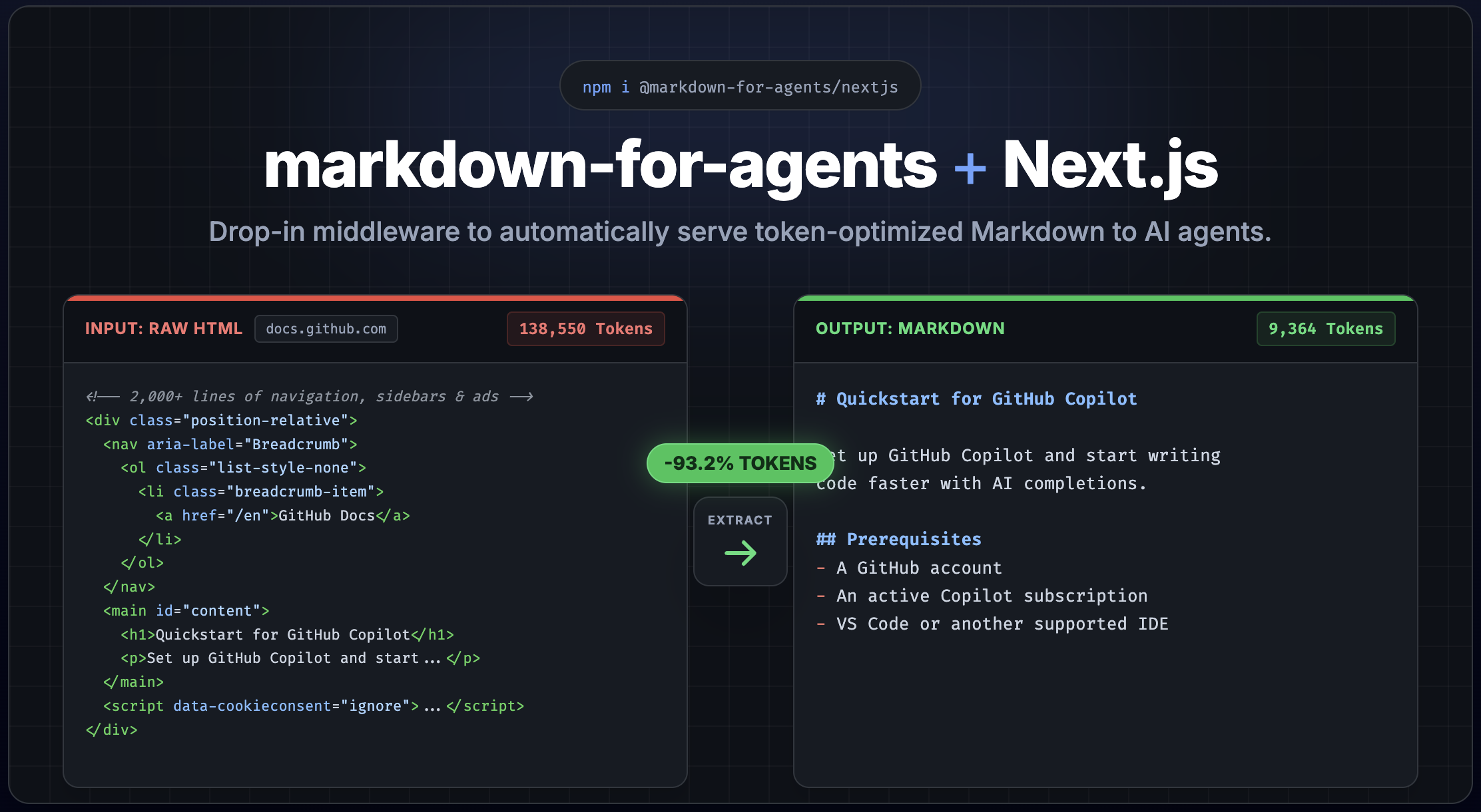
markdown-for-agents converts HTML to clean, token-efficient Markdown for AI agents — typically saving 80–90% of tokens. This package adds automatic content negotiation to your Next.js app via
Accept: text/markdown. Try the playground to see the core conversion in action.
Add a proxy and AI agents get clean, token-efficient Markdown instead of HTML. Normal browser requests pass through untouched. Includes a built-in rule that unwraps Next.js /_next/image optimization URLs back to their original paths.
How it works
The middleware uses content negotiation. When a client sends Accept: text/markdown, HTML responses are automatically converted to Markdown. The response includes:
Content-Type: text/markdown; charset=utf-8x-markdown-tokensheader with the token countETagheader with a content hash for cache validationVary: Acceptheader so CDNs cache HTML and Markdown separatelycontent-signalheader with publisher consent signals (when configured)Server-Timingandx-markdown-timingheaders with conversion timing (whenserverTiming: true)
Install
npm install @markdown-for-agents/nextjs markdown-for-agents
markdown-for-agentsis installed automatically as a dependency.
Usage
Use a Next.js proxy for site-wide conversion. The proxy checks the Accept header and fetches the page as HTML before converting:
// proxy.ts
import { NextRequest, NextResponse, NextFetchEvent } from 'next/server';
import { withMarkdown } from '@markdown-for-agents/nextjs';

const options = {
    extract: true,
    deduplicate: true,
    contentSignal: { aiTrain: true, search: true, aiInput: true }
};

export async function proxy(request: NextRequest, event: NextFetchEvent) {
    const accept = request.headers.get('accept') ?? '';
    if (!accept.includes('text/markdown')) {
        return NextResponse.next();
    }

    const handler = withMarkdown(async (req: NextRequest) => fetch(req.url, { headers: { accept: 'text/html' } }), { ...options, baseUrl: request.nextUrl.origin });

    return (await handler(request, event)) ?? NextResponse.next();
}

export const config = {
    matcher: ['/', '/about', '/blog/:slug*']
};
How it works
The inner fetch sends accept: 'text/html', so when the request re-enters the proxy it hits the early return NextResponse.next() and renders the page normally — no infinite loop. Only Accept: text/markdown requests take this path; all other traffic passes straight through.
sequenceDiagram
    participant Agent as AI Agent
    participant MW as Next.js Middleware
    participant Page as Next.js Page

    Agent->>MW: GET /about (Accept: text/markdown)
    MW->>MW: Detects text/markdown
    MW->>Page: fetch /about (Accept: text/html)
    Page-->>MW: HTML response
    MW->>MW: Convert HTML to Markdown
    MW-->>Agent: Markdown response (text/markdown)

    Note over Agent,Page: Browser requests (no text/markdown) pass straight through
Tradeoffs
This pattern makes a second HTTP request to your own server for every Markdown conversion. Next.js proxy runs before page rendering and has no access to the response body, so there is no way to avoid this round trip within Next.js itself.
In practice this is usually fine:
- Latency — the second request is localhost-to-localhost (or edge-to-edge on Vercel), so it adds minimal overhead.
- Compute — your page renders twice for AI agent requests. For static or ISR pages this is a cache hit. For dynamic pages the extra render is the main cost.
- Scope control — use
config.matcherto limit which routes are eligible, so non-content pages (API routes, auth, assets) are never double-fetched.
Real-world timing
Measured on a production Next.js site deployed to Vercel (enable with serverTiming: true). The x-markdown-timing header breaks down the two phases. Token counts are for the converted Markdown output:
| Page | Tokens | Vercel cache | Proxy fetch | Conversion | Total |
|---|---|---|---|---|---|
| Landing page | ~500 | HIT | 31ms | 1.4ms | 32ms |
| About page (cold) | ~1,000 | PRERENDER | 325ms | 1.7ms | 327ms |
| About page (warm) | ~1,000 | HIT | 43ms | 1.5ms | 45ms |
| Long article (cold) | ~3,200 | PRERENDER | 443ms | 76ms | 519ms |
| Long article (warm) | ~3,200 | HIT | 36ms | 21ms | 57ms |
Takeaways:
- Conversion is fast — 1-21ms for cached pages, up to ~76ms for a 3,200-token article on a cold hit.
- Proxy fetch dominates — the self-fetch to get the HTML is the main cost, not the Markdown conversion.
- ISR/static pages are nearly free — once Vercel has cached the HTML, the proxy fetch drops to 30-45ms (edge-to-edge).
- Cold hits include SSR time — the 300-440ms proxy fetch on
PRERENDERis Next.js rendering the page server-side. Subsequent requests are fast.
withMarkdown automatically includes nextImageRule, which unwraps /_next/image optimization URLs back to their original paths. For example, /_next/image?url=%2Fphoto.png&w=640&q=75 becomes /photo.png in the markdown output.
You can also use nextImageRule standalone with the core convert function:
import { nextImageRule } from '@markdown-for-agents/nextjs';
import { convert } from 'markdown-for-agents';

const { markdown } = convert(html, { rules: [nextImageRule] });
Full working example: See
examples/nextjs/for a complete Next.js app demonstrating the proxy pattern with integration tests.
Options
Accepts all markdown-for-agents options:
const handler = withMarkdown(async req => fetch(req.url, { headers: { accept: 'text/html' } }), {
    // Strip nav, ads, sidebars, cookie banners
    extract: true,

    // Resolve relative URLs
    baseUrl: 'https://example.com',

    // Remove duplicate content blocks
    deduplicate: true,

    // Custom token counter (e.g. tiktoken)
    tokenCounter: text => ({ tokens: enc.encode(text).length, characters: text.length, words: text.split(/\s+/).filter(Boolean).length }),

    // Publisher consent signal header
    contentSignal: { aiTrain: true, search: true, aiInput: true }
});
Other frameworks
| Package | Framework |
|---|---|
@markdown-for-agents/express | Express |
@markdown-for-agents/fastify | Fastify |
@markdown-for-agents/hono | Hono |
@markdown-for-agents/web | Web Standard (Cloudflare Workers, Deno, Bun) |
License
MIT